


Efficient Spare-Parts Pricing: Challenges and Success Factors for Pricing Managers
In many companies, the spare-parts business is one of the particularly profitable areas – often even more profitable than the sale of new products. Yet it is precisely in spare-parts pricing that weak points keep emerging, frequently jeopardising commercial success. Inefficient processes, faulty base data and unwieldy Excel spreadsheets are just some of the challenges pricing managers face day in, day out. It is worth examining the typical problems and pointing out practical solutions through which mechanical and plant engineering companies can sustainably optimise their pricing processes.
Challenges from the perspective of a spare-parts pricing manager
1. Small teams with vast amounts of data
A major bottleneck in spare-parts pricing lies in the staffing structure. Often it is small, frequently overstretched teams or even individual specialists who are responsible for hundreds of thousands of items. This immense volume of data is frequently still managed in simple Excel spreadsheets. Excel is certainly a flexible tool, but when processing such volumes of data its limitations quickly become apparent: manual maintenance and updating is not only extremely time-consuming but also carries a high risk of error. In practice, one all too often sees that the bulk of the time is taken up with firefighting and repetitive tasks – at the expense of price quality.
2. Poor data quality as a stumbling block
The basis of every well-founded pricing decision is precise and up-to-date data. Unfortunately, this is often not the case in spare-parts pricing. Incomplete or faulty cost data – caused by unreliable ERP systems or necessary manual corrections – means that individual prices are formed on the basis of incorrect input data, particularly in cost-plus pricing.
These inaccuracies have a direct impact on profit and can quickly add up to significant unrealised margins. Almost worse still is the risk of ruining your own price image if the inconsistencies also affect focus parts. A further problem is the enormous amount of time invested in manual data maintenance – capacity that could be used to maintain prices for important parts.
Poor data quality thus acts like a stumbling block and prevents the full potential of spare-parts pricing from being realised.
3. Limited pricing methods and a lack of market transparency
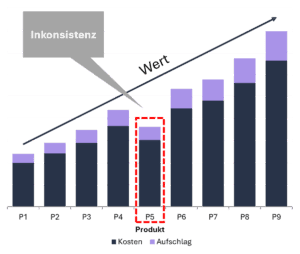
Many companies still rely on traditional cost-plus pricing. This is fundamentally sound, because it provides a solid basis and ensures that costs are always at least covered. In practice, however, it often turns out that the method reaches its limits when inconsistencies arise. If individual parts of a product family have significantly lower costs – e.g. through economies of scale or particularly good purchasing terms – margin potential is given away, because the static mark-ups of cost-plus pricing do not compensate for this.
Particularly in segments where spare parts perform a critical function, a differentiated approach would make sense. In addition to cost-plus pricing, value-based methods are needed that are able to form prices independently of costs, based on the perceived value from the customer's perspective. Only then can internally consistent prices be determined.
4. Missing price history and documentation
When prices are changed over time, it is difficult to document the changes in a traceable way. All too often it is barely possible to reconstruct the assumptions on which past price adjustments were based. Maintaining traceable documentation in the form of Excel price lists is, given the sheer number of items and prices, essentially a hopeless undertaking.
But all of the challenges mentioned can be solved. In what follows, I describe how it can be done better and how profit potential can be unlocked from it automatically.
Success factors for effective spare-parts pricing
1. Data structure as the basis for well-founded pricing decisions
The first step towards efficient pricing lies in creating a uniform and robust data structure. To begin with, this requires a well-thought-out technical master-data hierarchy. Most companies often see this as their biggest hurdle. Yet most of the information is available and, with the help of well-trained large language models, can be brought into shape with relatively little effort, forming – with a little manual fine-tuning – a solid basis for spare-parts pricing. As a rule, AI can reduce what is often months of classification work to just a few days.
2. Spare-parts pricing tools instead of Excel: automation for better price quality
Switching from Excel spreadsheets to professional pricing software is another decisive step towards greater efficiency. Modern pricing tools enable automatic price calculations based on current data straight from the ERP system.
This not only minimises manual errors but also saves considerable time resources. Professional tools also offer extensive functions that allow you to act in a targeted way in day-to-day business on the basis of pricing KPIs, and to price entire portfolios at the push of a button using pricing rules.
The investment in modern pricing solutions usually pays off within a few months of implementation – in the form of greater efficiency and increased profit margins.
As an independent pricing consultant, I am also a partner of nueprice, the software for spare-parts pricing. I would be happy to show you in a demo how you, too, can put such software to work for you.
3. More than cost-plus: deploying intelligent pricing methods
A well-differentiated cost-plus pricing approach forms the basis for more advanced pricing strategies. Building on this, more intelligent methods can be deployed to realise the full potential of the spare-parts portfolio. These include, among others:
- Family pricing: value-based pricing for product families, in which prices are aligned with value drivers independently of costs.
- Kit pricing: pricing strategies for spare-parts kits that optimise the overall value of the package.
- Competition-based pricing for focus parts: prices for strategically important spare parts are set on the basis of market and competition analyses.
These methods build on well-founded cost-plus pricing and enable targeted differentiation. Through an intelligent, software-supported combination of these methods, significant potential can be unlocked and competitiveness sustainably increased.
4. Automatic error detection and margin monitoring
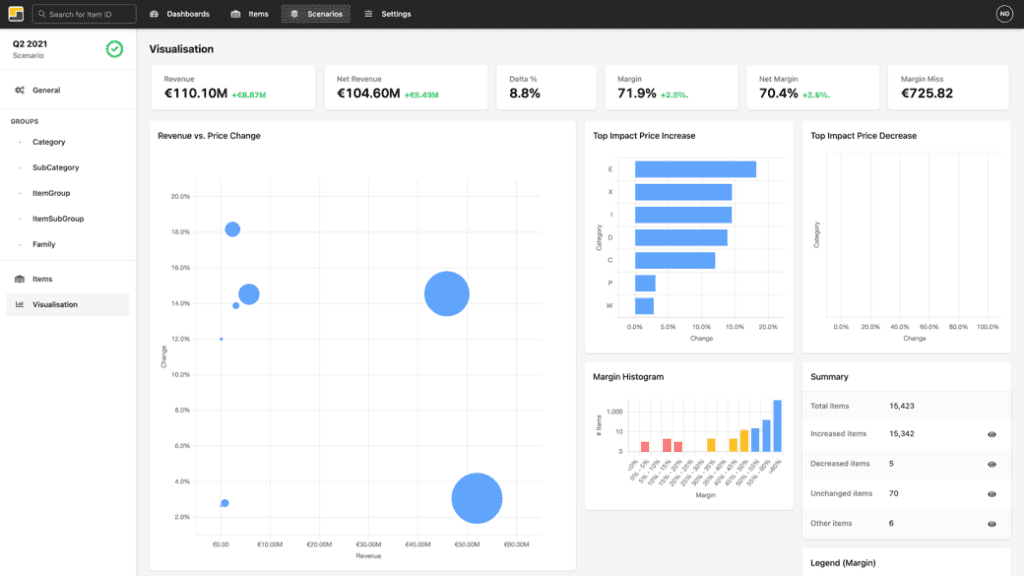
To increase profitability sustainably, it is essential to identify faulty cost data and inadequate margins at an early stage. Such systems continuously analyse the data from the ERP system and signal immediately when prices that are too low or incorrect cost entries are detected. Transparent dashboards give the pricing manager a comprehensive overview of all relevant key figures and enable rapid intervention when adjustments are necessary.
Conclusion: how pricing managers transform their processes
Optimising spare-parts pricing begins with building a sound master-data hierarchy. Companies that modernise their pricing processes benefit from greater efficiency, better margins and a stronger market position. Through a combination of automation, well-founded data and intelligent pricing strategies, sustainable competitive advantages can be achieved.
Feel free to get in touch. In a joint sparring session, we will look at your spare-parts pricing challenges and discuss possible solutions for your pricing practice.