


The Right Positioning: The Key to Market Success
In today's tense market environment, a good product alone is no longer enough. Companies therefore need clear positioning in order to retain customers over the long term and stand out from the competition. In this article you will learn how to position your products strategically in the market and thereby increase your sales and your margin.

What does positioning mean?
Positioning is a strategic process in which a company's products and services are deliberately placed in the market. The aim is to support the overarching corporate strategy and the pricing strategy derived from it. It encompasses the strategic alignment of one's own brand and the coordination of the prices and performance of individual products. Both approaches are closely linked, but pursue different objectives.
- Brand positioning describes how a company presents itself as a whole and how it becomes anchored in customers' minds. With regard to prices, the question here is whether a company is perceived as a premium or a mass-market provider.
- The price-value ratio focuses on the pricing and value proposition of a product in comparison with the competition. This ensures that products are positioned in the market in a way that fits the corporate and pricing strategy and supports it.
Risks of unclear positioning
A skewed price-value ratio often leads customers to perceive the product as either too cheap or too expensive. As a result, they may misunderstand the offering or see no added value compared with other products. This can cause the company to lose market share and suffer under competitive pressure. A well-considered positioning strategy, by contrast, gives the product a clear profile and fosters lasting brand loyalty.
Determining your own positioning
Successful price-value positioning is based on a clear corporate strategy that serves as a guide for pricing and product positioning. This process can be divided into three essential steps:
- 01Develop the corporate strategy: First, the company defines its overarching strategy. Among many other questions, it must decide whether the focus is on growth and revenue increase or on profitability. It should also be clearly defined how the company wants to position itself in the market – as a premium or a mass-market provider.
- 02Derive the pricing strategy: Based on the corporate strategy, a pricing strategy is developed that is either revenue- or profit-oriented. How this lever is set feeds in as one factor into the ultimate price-value positioning of the individual products.
- 03Define product placement: Products should be positioned in the market in such a way that they support the corporate and pricing strategy. Every product must offer a clear price-value ratio that fits the brand and the company.
Key questions on price-value positioning
To define the price-value positioning of a product, central questions must be answered:
- Who are the relevant competitors and their products? And which alternatives do customers consider comparable? If the competitors are known, differentiation becomes easier.
- By which criteria do customers decide on a product? Customers often choose on the basis of various factors such as price, quality, functionality or brand awareness. It is therefore important to know the criteria in order to highlight the corresponding advantages of the product.
- What do comparable competitor products cost? An analysis of the prices of similar products provides insight into how your own product can be positioned in terms of price in order to remain attractive within the competition.
The Price-Differentiation Map as a strategic tool
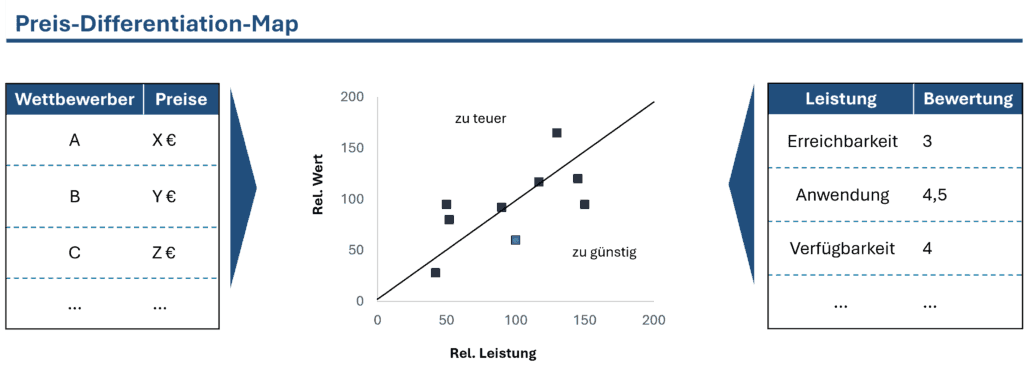
A useful tool is the Price-Differentiation Map. For this, the placement of your own product relative to the competition is presented in a chart, making visible the relative prices and performance of all relevant products in the market.
The Price-Differentiation Map shows the price-value ratio of products on a two-dimensional map. The X-axis represents the price level, while the Y-axis maps the perception of performance such as quality and features. This makes it easy to visualise your own position and that of competitors, so that weaknesses and opportunities become immediately apparent.
Advantages of the Price-Differentiation Map
- Clear market overview: it shows the relative positioning of your own product in terms of prices and performance in relation to competitors.
- Identification of optimisation potential: over- or undervalued products can be quickly identified and price-value adjustments made.
- Strategic differentiation: the map provides a solid basis for the argumentation towards customers and for differentiation from the competition.
Customers' willingness to pay
The perspectives considered so far – the internal perspective (who do we want to be?) and the competitive perspective (how do other providers position themselves?) – provide valuable information for setting the price point. But to sharpen the positioning further, the customer's perspective is decisive.
To determine the target group's willingness to pay, market research uses methods such as Gabor Granger or Van Westendorp. Together with the analysis of the differentiation criteria from the customer's perspective, this results in a well-founded perspective for optimally adjusting the price point. As a result, the price remains competitive while at the same time matching customers' actual expectations and willingness to pay.
Examples of successful and failed positioning
The right placement of products can contribute decisively to market success, while a failed strategy can harm the company.
Successful positioning
- Apple: with a clear premium positioning and a high standard of innovation, Apple has established itself as the market leader in the high-end segment and achieves high margins.
- Aldi: positioning itself as the cost leader in the discount segment with a good price-value ratio in the low-price segment has earned Aldi a large, price-sensitive customer base.
Failed positioning
- Pepsi Crystal was an attempt by Pepsi to tap into the market for health-conscious customers with a new soft drink. But the product missed its target group because it was too similar to the classic Pepsi branding. In addition, the premium price deterred many potential buyers.
- McDonald's Arch Deluxe was intended to appeal to a premium target group. But the product failed because it did not fit the general perception of the brand.
Conclusion
Targeted price-value positioning is an important factor for the success and competitiveness of a company. It provides clarity about how a product is offered in the market and how it is perceived by the customer. Developing a corresponding strategy is demanding and requires comprehensive knowledge of the market and the target group.
Since precise positioning has a major influence on profitability, it is advisable to consult experts. I would be happy to support you in developing a tailor-made strategy.